


Orang Asli wearing the crown (pelilit kepala) with their musical instruments of bamboo.

The entrance to the Orang Asli Museum
Last week, after our Sunday morning exercise, the next best thing my husband and I did was to visit the Orang Asli Museum in Gombak.
Some might say it's off the beaten track but I assure you it's just 22 km from the city. Along the way, you get to soak in the slower pace of life as you pass villages to reach there.
The Orang Asli Museum is really an undiscovered gem as many have not heard of it before. Some Korean visitors were there before us as we signed in the register book.
The Museum has a comprehensive array of exhibits and they cover the gamut of Orang Asli living. It was so long ago that I learned about the Senoi, Negritoes and the Jakuns in Geography lessons. However, not so long ago, we visited Orang Asli settlements in Belum and Kuching. This visit just tops up the general interest as the Museum has dollops of information to share.

Originally the Orang Asli clothes were made of leaves and the outer layer of wood.

Traditional medicine -awake parsnip (ubi jaga), 'ali' crosier (tongkat ali), kacip fatima

Food hunting in various ways. This shows a trap for a mouse. Bird lime, a sticky resinous stuff from the sap of certain trees are used to trap birds. Different kinds of traps are made to snare pelanduk , pig, squirrel.
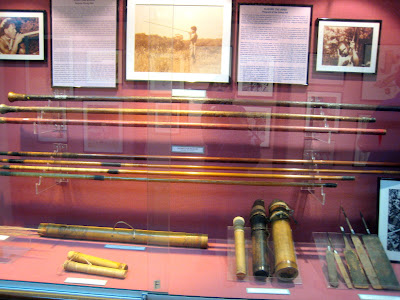
Blowpipes are the classical and multipurpose weapons to fend off enemies or to kill prey. It is easy to carry, economical, light and easy to store away. Most are made of bamboo, some of wood. They can cover a target range of 40m., accurate and dangerous in skilled hands. The poison is from the Ipoh tree (antiaristoxicaa)

A Mah Meri (sub group of the Senoi) wedding

Senoi Paraaq Corner - 'Paraaq' means fighting people. It refers to the battalion of the PPF (Police Field Force) whose members were exclusively Orang Asli and was formed in 1957 to counter the influence of the communist insurgents. In 1968, the Senoi Paraaq was absorbed into the PPF. Today, they total 1300 in strength.
Business at Noraida's stall outside the Museum was quiet. In the leisurely chat, we found out that Noraida's parents still live in the jungle in Kuala Lipis, Pahang. The crafts sold at their shop are the handiwork of her grandparents , who still prefer their traditional way of living in the long house. It takes 3 hours to walk from the interior to the town.

School's out for them as there never was a chance for them to go to one. We were alarmed that Noraida's younger sister was a dropout and we gave our friendly advice that education is the way forward.

The youngest member having a spin of the gasing gesek (' friction' gasing)
We came away with some crafts - all as gifts to my nephew and niece as they love simple toys Moreover, with them, we have stories to tell about a group, often forgotten in our mainstream. The younger generation are opting for a new way of life and soon the time will come when the jungle is their second home.
Orang Asli Museum
KM24, Jalan Pahang, Gombak
53100 Kuala Lumpur
Te; + 603 6189 2122


 Posts


