Showing posts with label nature tourism. Show all posts

Thursday, September 13, 2012

Hawksbill turtles calling at Pantai Padang Kemunting, Melaka


I was excited the day had arrived to be a turtle volunteer even for a mere day and a half. Thanks to blogging pal, Ee Lynn for her efforts and sharing. Our short stint at Padang Kemunting was a wonderful experience with the hawksbill turtles, marine treasure of Melaka.

My first experience with turtles was way back in the early 80s. Then the great leatherback turtles were returning to our shores in Trengganu on the East Coast. We had a natural heritage that we should have held so close to our hearts. But poaching, overfishing and pollution etc took its toll. Thankfully, sometime in 2010,a giant turtle made a surprise visit to Rantau Abang. Conservationists dubbed her 'Puteri Rantau Abang'(Princess). We long to see Puteri back to our shores.

Our turtles must be protected. Besides the conservationists doing their bit, we can also do ours following some simple steps:

1. Stop eating or buying turtle eggs in the market
2. Abide by the law. Only licensed collectors are allowed to collect eggs. Report illegal activity.
3. Do not disturb turtles that come up to the beach to nest.
4. Keep the nesting beach quiet and dark.
5. Stop using fishing gears that are detrimental to turtles.
6. Do not pollute the habitats of turtles eg. beaches, rivers and seas.


We were relieved to see this sign as we had to ask for directions to the Centre. TIC started operation in 1990, collaborates with WWF to implement outreach programmes  and do research to protect the decreasing numbers of hawksbill turtles that come to land  along the coast of Melaka and the islands nearby.

In the Audio room, a placard ( in Malay)  by a toy turtle which says, " I promise not to eat, buy and sell turtle eggs.'  All part of the education outreach as  poaching of eggs is still practised.

Volunteers, Mary and Sheela  helping to keep the  hatchery area clean of debris and the fallen leaves from the ketapang trees.

A young volunteer learning, observing.


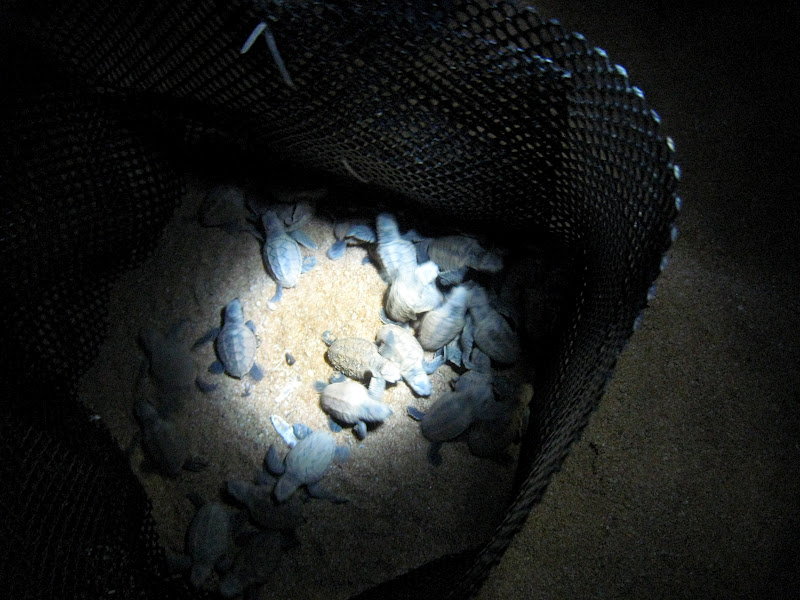
45 -56 days later  baby turtles will emerge .

Encik Mohamad  explaining the data on the placard :  date  the eggs were laid,  number of eggs in the hatchery, location of  hatchery, place of nesting , licensed collector's name


Hurray! the little ones are ready to be released to the open sea.

Past 3.40 am  on the beach, looking out. A miscommunication occurred, so we missed the hawksbill turtle that had come to do its duty and leave for the open ocean again. Safe journey... Do come back again, dear turtle.

Volunteer Stefan handling the tutrle with care, transferring from the pond to  the bath enclosure. There are 4 other turtles kept for research and rehabilitation. They will be duly tagged,  released by biologists when deemed ready.

It's bathtime, mate! We cleaned the shell (carapace) to remove the  algae  to prevent parasites from breeding.

Swim, swim swim - in the pond at the TIC . Note the green colour of the algae on the shell.

Rapt attention on the turtles.

In his book, Pakcik  Harun, one of the licensed collectors, keeps records of nestings etc. He's  been a custodian for  20 odd years and faithfully patrols the beach.

We came together for the turtles. 

Thursday, January 20, 2011

Coir rope making - Kerala

What caught my attention were 2 Indian women each with a big pouch  hugging  their waists. In it was filled with coir. Curious and interested to find out more about this activity, I walked closer to the women.  First I watched as these ladies proudly displayed their skill for all to see and participate on the lawn at Kumarakom Lake Resort. One of the ladies in  a blue sari was eveready to show. It's a 'delicate' art to 'feed' the rope and let it go. Any jerky movements and  heavy handedness will cut off the continuity of the rope. Needless to say I broke it! Then came the repair which was nicely joined by my teacher.

Think of all the coir ropes you have seen and used. It is highly probable that some would have come from India as coir rope making is an important  thriving cottage industry especially in the coastal region of Kerala. Womenfolk support this industry

Say ' Coconut' when in Kerala!  You'll love the tall sway of the trees. In almost every home, coconuts are grown. Even before the plane landed in Bangalore, the palms are beckoning a warm tropical welcome down below ! The clime suits this versatile plant and has blessed  Kerala with so many spin -offs. Coir is one of the by - products of this plant. It is a natural fibre extracted from the husk between the hard internal shell and the outer coat of a coconut. One hundred per cent natural, eco- friendly and water absorbent without weakening its strength, the coir is used for numerous products e.g.door mats, floor mats, mattresses, brushes, etc.

Joey! I thought but Kerala women have different ideas


A lesson in the light touch -' feed' the rope from the tangled coir  and it will lengthen


One of the ladies spins the wheel. 
In the background, a huge pile of fibres.

Two ladies making the length of the rope. The women walk backwards several  hundreds of times a  day!

Patiently she sits and spins.  Coconut fibres are attached to hooks.
The wheel is turned by hand.  In the process the coir is twisted. 

The lady approaches the wheel with a block of wood which brings the 2 ropes together. It is then unhooked and ready for the pile.
.
2 strings entwined as one rope  - a strong rope is ready for use. Job accomplished.

All in a day's work

 Lighter than carrying a baby !

 The pouch(basket really!) is  a piece of cloth wrapped round the lower part of the body.
One of the ends is  brought up to be a basket to hold the fibres.


Friday, January 14, 2011

Life by the backwaters of Kerala

Kettuvallom/ Kerala houseboat

.We nearly missed it but thankfully we didn't! Tourists have a once in a lifetime experience on Kerala backwaters and return home with memories to last a lifetime. December being a peak season for tourists, the houseboats were fully booked. Luckily, the General Manager of the Kumarokam Lake Resort  got us a  country boat to enjoy a 2 hour ride. That satiated our longing for a taste of the backwaters though the real experience in a full fledged houseboat to pamper your body and soul  will be something really special .

The backwaters of Kerala is a chain of brackish lagoons, rivers canals  and lakes lying parallel to the Malabar coast of Kerala state. This extensive network of waterways provides livelihood for the locals and its natural charm has brought tourists flocking to Kerala.

The boatman took charge of the 6 seater country boat. Being smaller than the big houseboats, it can traverse the narrower canals.

We left Kumarakom Lake Resort situated on the shores of Lake Vembanad. Sitting in the boat, Lake Vembanad looks like a vast sheet of glassy water, serene and tranquil.  The big houseboats, small and large ( 6 rooms and other amenities to boot) were already 'skimming' the surface and going to the  backwaters of Alleppy and the numerous canals. These Kettuvalloms are really traditional grain and spice barges that have been converted to houseboats. A tourist from USA told us she wasn't sure how to cope with the idea of 3 attendants for the 3 days she was the sole person staying on the  houseboat. It seemed so sinfully luxurious  to her. Well, we both agreed that while it lasted, just yourself enjoy before reality hits !

 Before long we were in the backwaters. I plonked myself on the front wicker chair, eager to catch the view and the sun ! We drifted along. A new world opened before our eyes and thoughts of sailing on the Mekong some years  flashed through my mind. The waters lapped as the boatman took us on easy, slow ride.  Nothing comes closer than  this  - having  clear images of  the engaging rustic life of  the people who live on the banks. We passed through  rural settlements sited on narrow strips of land between waterways. 'Hello, world!' - the hive of activity with villagers going about their daily lives is a reminder of the importance of waterways in civilisations gone by and the present.


The lush greenery greeted us everywhere. Swaying coconut trees, mangrove swamps, palms, bananas,  pandanus, leafy plants hug the banks and  mango trees already laden  with flowers, so many familiar plants that remind us of our own tropical vegetation back home. 'This Kerala) is India at its greenest and no other state can beat it', my husband hastened to add .Water hyacinths bobbed  and  floated effortlessly  in thick clusters  here and there.

Bird life is plentiful and without binoculars, we could seen their plumage as their hovered and flew above our heads.

There's also a place called home in these boats  
Think you can float effortlessly on this glassy  Vembanad Lake?


Lush greenery on either banks of the canals. The coconut trees lend such elegance to the scenery. Beyond lie paddy fields resting before the next cultivation. 
We watched as he rowed, into the hyacinths which parted as he meandered to his destination

Women power by the banks


A wedding


In flight , the white heron is part of the avian population. As we passed by in mid morning birds were aplenty flying past. The famed Kumarakom Bird Sanctuary is nearby.


Rub-a dub- dub - the best view from his 'private' spot !


The daily chores go on. Men  transport goods from one village to another in their low slung dug out canoes. 


The boat almost disappearing due to the heavy rocks being transported to build an embankment


A smile bridges people, a bridge, life


The children are naturally happy to see visitors


Vivid orange, green, pink, blue buildings seem to be popular colours that dot the lush landscape. 


Fishermen preparing their nets for their catch. Fish is plentiful in Kerala and eaten daily. 


Such infectious laughter, welcome as kids know best


Very much part and parcel of Kerala life, the elephant adds extra interest to passers-by on houseboats


The steps leading down to the waterways where daily activities take place. A school in the background.

Recyclables - waste not, want not  

Astounding  varieties of architecture in the numerous churches  in Kerala. None are the same!!

Wouldn't  I want to be in one of these when I visit again!

Comorants perch and watch keenly for their feed

The country boat that took us to the backwaters

Sailing away from Kumarakom Lake Resort where we stayed for 2 nights. 

Saturday, January 1, 2011

The Elephant Sanctuary,Guruvayur, Kerala


Gently lift it!

Meet one of the 65 elephants in the sanctuary, the only one of its kind in the world. Rich devotees of the Lord Krishna donate elephants as offerings. We were told that an elephant costs about 1 lakh which equals 100,000 rupees. The elephants are well looked after, there is no breeding.


Coconuts are synonymous with Kerala and in this sanctuary their home, elephants feed and live

A hillock of elephant dung and there were plenty and more around


I'm back! Thanks to each and everyone for your wonderful wishes. Hope you're enjoying the year end festivities and keeping well. The 2 week holiday in Bangalore and Kerala is over! All good things have come to an end. It has been a roller coaster of memorable happenings. The main purpose was to visit Ravi's maternal relatives who are Indian citizens. Being intrepid travellers, we soaked in and squeezed in as much of India as we could savour as we moved among the destinations. Where did we go? Many places - Bangalore, Trivandrum, Kovalam Beach, Cape Comerin, Thekkady, Kumakoram Lake Resort, Mulanthuruthy, Kochi and Trisshur. Looking back it has been amazing. First of all, the relatives are truly ambassadors of India. They accorded us a truly warm welcome. We have in our hearts their wonderful smiles and hospitality wherever we went. These memories are precious.


In Bangalore, Johnny our cousin made us feel so much at home. There was never a dull moment with him. Luckily being retired, he caught up with us again down south to Mulanthuruthy and Kottayam, Kerala. News had gone round that Ravi and his wife and daughter from Malaysia were visiting. Even our cousin, Mohan from Chennai flew in to join the huge gathering. It was as if the whole village of Mulanthuruthy (where his late mother was born) had come to get to know us better and exchange lots of stories of family ties and we delighted in exchanging mundane daily stories in a family guest house. The VVIPs were Ravi's 92 year old uncle and 85 year old aunt. He was toasted with whisky by the menfolk and he got a peg or two of rum his favourite. Over so many typical Kerala meals we sat and talked. Indeed it was a gastronomical feast not forgetting the big party where liquor were downed so liberally beginning with fish and other snacks before the actual meals took place. I think we've covered almost all of the Kerala cuisine! Yes, we had the dishes for breakfast, lunch and dinner. Very quickly I realized my usual breakfast of 2 slices of toast with peanut butter/ jam and a cuppa of tea will have to wait till I reach our shores again!! Each meal was a journey for our tastebuds though some not totally strange as we are familiar with some South Indian cuisine. That meant we ate till our hearts' content and pleaded (politely!) we couldn't have anymore!! Which also meant we added a few kilos of weight to each of us. I fell in love with the kurtis and was always eager souvenir hunting for traditional crafts as gifts to friends and relatives. Our guide, Shibu to the various destinations was a superb driver on Indian roads which admittedly can have many pitfalls!! What would all the drivers do without their car horns??

Despite the tight schedule we kept I 'm so glad I had some lovely moments with my blogging friend Indrani and her family in Bangalore. She made a special visit to our cousin's house. As we hugged, it was as if we had known each other for a long time! Indrani 'popped up' from cyberblog when I started blogging in March 2009. Upon my request our scientist cousin, Sarjan in Trivandrum got me to my blogging friend, Dr Antony's house to meet up with his wife Celine and their grandson. He had arranged for us to meet as he was still in Dubai. That notched up for me having met 3 blogging friends overseas including Trotter in Lisbon last December.


The visit to the world renowned elephant sanctuary was second last on the list in Trisshur where our cousin Baju, an opthalmologist lives with his family.

This sanctuary was highly recommended to tie in with the visit to the temple at Guruvayur. Only Hindus are permitted to enter this place of worship so my daughter and I waited outside while my husband paid homage to Lord Krishna. It was a pity we couldn't linger as the time schedule was tight to depart from Kochi back home.


When we got there the public area was filled with a sea of faces. Not knowing Malayalam, we stuck very close to the driver who speaks very little English. We were caught among huge crowds of wedding guests and devotees. The throngs remind me of the Thaipusam festival back home. In such an atmosphere, be prepared to be in 'auto' mode as the crowds move you along! Every devotee had to pass by a metal detector and security guards before entry into the temple proper.

Rajan the driver then drove us to the elephant sanctuary. As we alighted the vehicle, the smell of dung hit the air. 'Poo!' we chorused aloud and indeed there were mounds of them.

So friends, to start the year 2011 with a bang, fresh from a truly memorable visit to Guruvayur, Kerala here's JUMBO greetings from me to you ! I wish you good health, happiness and wealth. Thank you very much for visiting my blog and your encouraging comments. Happy 2011 and may God bless you.


A vast land to accommodate these huge elephants 20 -40 + years old


I think he overdid it. Some of the feed landed on his back!


One of the tuskers feeding and shutterbugs clicked away keeping a safe distance from the animals


Just a gentle reminder

The classic Ambassador car fondly known as 'King of the Indian Roads' parked next to our vehicle. There was an immense crowd as there was a wedding outside the temple.

My husband getting a helping hand  from his cousin in Trisshur to wear the dhoti tied the Kerala way


The long queues to worship in the most famous Krishna temple in  the town of Guruvayur, the Lord Sree Guruvayurappan temple. It is one of the most famous pilgrim centres in South India. Thousands of pilgrims come from all over India.


Holding on to their shirts, the men have to be bare chested before entering the temple. This is part of the homage to the deity


Women in sarees and men in dhotis

The high shine of the brass - for ornaments and worship for sale . As we walked past, the glow  seemed to reflect on us too!
Parents helping the young ones to wear the dhotis before entering the temple.


Ayyappa devotees recognisable in black dhotis and bare footed also joined the throngs. 
We came across many of these worshippers during our stay in Kerala. The devotees follow a strict 41 day austerities (vruthams) preceding the pilgrimage to the shrine at Sabrimala

Fragrant jasmine flowers from vendors  for wearing on hair or for prayers

One of the very colourful shops displaying ornaments and other paraphernalia