Showing posts with label Masjid India. Show all posts

Tuesday, December 15, 2009

How to wear a saree


Ms Thilaga of Madras Store, Masjid India is no stranger to her customers. Year in , year out, over the past 30 years, she has served countless numbers of ladies, including me - advising on the types of sarees to buy to suit the occasions.

Her knowledge of sarees is in-depth. Just touching the fabric and looking at the patterns, she's able to say if it is a Kanchipuram saree (pure silk from Chennai) or a Benares (from Delhi). Moreover, with her keen eyes, she offers advice on what suits the wearer.
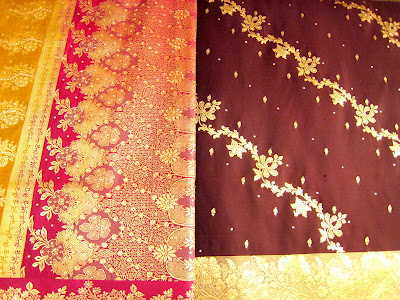

Benares silk saree materials


I was interested just in wedding saree materials since I'd be attending one soon. The most auspicious colours for weddings are red and yellow. I asked Ms. Thilaga the prices and they nearly knocked me down flat!! 'That one in the corner is RM 4,000.00.' I took a closer look - the beadwork and the intricate stitching of the gold threads made the saree look like one in a million! Really exquisite!


A richly embroidered paisley motif


'Sarees are easy to look after,' she says. 'Just air them once in a way.There's no need to store them in a camphor chest as in old wives' tales. Only dry clean them , should one feel one has to. Choose reputable dry cleaners, though,' she cautions.

I requested to see a ready-to-wear saree. She picked a polyester saree and and in a jiffy, she was draped in a saree. Honestly, where's the fuss in wearing/tying a saree? The pleats are there at the front and with the velcro at the waist and a quick wrap around and a flip of the remaining saree over the shoulder, you're done!! As for the blouse (choli), it can be sewn within a day. So, if you're ready to step out in a saree, do not despair. There's a quick fix to look elegant.


You can step out in style in a ready-to-wear saree!


The length of a saree is 5 metres (6 yards). The saree comes in a variety of fabrics - handwoven, machine-made. One very traditional saree design is the paisley motif which is timeless and popular.


How to wear/tie a saree :

1. To start, wear the choli which is the tight - fitting saree blouse . Next, wear the long petticoat (pavadai) which is tied tightly at the waist by a drawstring.


2. Take the plain end of the saree and tuck it into the petticoat for one complete turn from right to left. This holds the saree in place. Make sure the lower end of the saree touches the floor and the petticoat does not show.


3. Beginning from the tucked -in end start making pleats in the saree - about 5 inches width. Hold the pleats together so that they fall straight and even.

4. Tuck the pleats into the waist slightly to the left of the navel, making sure the pleats are turned towards the left. The amount you tuck in depends on how tall/short you are or how long you want the saree to fall.

5. Drape the remaining portion of the saree across the torso and over the shoulder. The wearer now has the most decorative part of the saree, the pallu, to show off the beauty of the saree. It is held in place on the shoulder and secured to the blouse by a small safety pin (hidden). Finally when the saree is draped, the look should be neat and nicely fitted to the body.

A novice needs a few trial runs to achieve a neat look in tying a saree. But to the regular wearer, it is easy handling all 5 metres of material.


Ready to step out in a saree? Till the next post, do follow me to a Hindu wedding. That's where I'll be wearing this green silk saree of mine. And there'll be other ladies all dressed to the hilt in their lovely sarees too, especially the bride.


Thursday, November 26, 2009

Traditional wear - Baju Melayu / Songkok


Getting to Wisma Yakin, in Masjid India I had to wend through the busy crowds. It was noon when I made a beeline there to seek out the tailors of the Baju Melayu, a traditional Malay outfit for men and the songkok, headdress for men too. Wisma Yakin, by repute, is the popular place to get these clothings, especially during the month of Ramadhan.

It was a pleasant visit as I strolled into the shops. The shopkeepers gladly satisfied my curiosity as I asked questions pertaining to the Baju Melayu and the songkok.

I popped into Omar Ali shop, a family run business since 1948. Today, the business is in the capable hands of Omar Ali's daughter. There, Encik Abdul Rahman was busy cutting material for a Baju Melayu outfit. I found out he started as an apprentice at Omar Ali but today after 20 years of loyal service, he's done well.In fact, he's now the chief cutter. He says he only takes clients' measurements and cuts the materials. The sewing is passed on to another person. At a leisurely pace, he completes 7 -8 orders per day. Come big occasions like Hari Raya or Awal Muharram, the orders rocket to over 1000 and more !! I commented that business is good and he smiled in agreement.


The Baju Melayu is a Malay shirt with long sleeves, a standing collar and a pair of matching trousers. The samping (skirt) of the kain songket is worn at the waist to complete the dressing.

I learned there are 3 types of collars : teluk belanga, cheong sam and cekak musang. 'It was our Tunku who popularised the 'cheong sam' collar which has 3 button holes,'said Encik Abdul Rahman. However, the cekak musang collar, with 5 button holes is the most popular. The teluk belanga is collarless and it does not need any buttons. Customers can choose from a big variety of buttons - plain gold stubs, gem -like stones of various colours too.


In the shop are samples of the Baju Melayu shirts which are paired with different colours of the kain songket. This is to help the customer make their choices.Indeed, when the men stride out in their outfits, they look handsomely dressed.


There is a wide range of kain songket ( brocaded cloth) to choose from for the samping(' skirt'). Encik Abdul Rahman showed me the richly woven kain songket and he picked the most expensive. It costs a bomb! Did I hear RM 9,000.00? Well, it's hand woven and the gold threads make the intricate design so dazzingly beautiful. Hence the price.

He assured me the artisans from Trengganu, on the East coast of Malaysia make the best kain songket. Other kain songket are imported from Pakistan and India. Prices of course vary according to the materials and the intricacy of pattern of the gold threads.

For the young ones, there is the smaller version of the Baju Melayu and samping though the latter is already stitched like a skirt to make wearing easier.

There's no lack of songkok in Wisma Yakin. Shelves and table tops are stacked with songkoks, the traditional male headress. Black is the colour of songkoks worn, be it for weddings or funerals. The adult songkok size starts at 21 inches and the largest size measures 23inches ,the increment is one quarter of an inch for another size. It is made of cotton, velvet and some sport a satin border or varied colours of the kain songket.


The songkok is equally an important part of the dressing up for the men. Encik Abdul Rahman says business is brisk during the different important religious dates in the calendar year.


Skt. Ali Omar Ynus
17 Wisma Yakin
Jalan Masjid India, 50100 Kuala Lumpur