
Ms Thilaga of Madras Store, Masjid India is no stranger to her customers. Year in , year out, over the past 30 years, she has served countless numbers of ladies, including me - advising on the types of sarees to buy to suit the occasions.
Her knowledge of sarees is in-depth. Just touching the fabric and looking at the patterns, she's able to say if it is a Kanchipuram saree (pure silk from Chennai) or a Benares (from Delhi). Moreover, with her keen eyes, she offers advice on what suits the wearer.
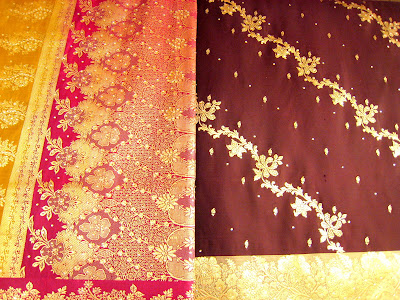
Benares silk saree materials

I was interested just in wedding saree materials since I'd be attending one soon. The most auspicious colours for weddings are red and yellow. I asked Ms. Thilaga the prices and they nearly knocked me down flat!! 'That one in the corner is RM 4,000.00.' I took a closer look - the beadwork and the intricate stitching of the gold threads made the saree look like one in a million! Really exquisite!
 A richly embroidered paisley motif
'Sarees are easy to look after,' she says. 'Just air them once in a way.There's no need to store them in a camphor chest as in old wives' tales. Only dry clean them , should one feel one has to. Choose reputable dry cleaners, though,' she cautions.
I requested to see a ready-to-wear saree. She picked a polyester saree and and in a jiffy, she was draped in a saree. Honestly, where's the fuss in wearing/tying a saree? The pleats are there at the front and with the velcro at the waist and a quick wrap around and a flip of the remaining saree over the shoulder, you're done!! As for the blouse (choli), it can be sewn within a day. So, if you're ready to step out in a saree, do not despair. There's a quick fix to look elegant.

You can step out in style in a ready-to-wear saree!
The length of a saree is 5 metres (6 yards). The saree comes in a variety of fabrics - handwoven, machine-made. One very traditional saree design is the paisley motif which is timeless and popular.
How to wear/tie a saree :
1. To start, wear the choli which is the tight - fitting saree blouse . Next, wear the long petticoat (pavadai) which is tied tightly at the waist by a drawstring.

2. Take the plain end of the saree and tuck it into the petticoat for one complete turn from right to left. This holds the saree in place. Make sure the lower end of the saree touches the floor and the petticoat does not show.


3. Beginning from the tucked -in end start making pleats in the saree - about 5 inches width. Hold the pleats together so that they fall straight and even.
4. Tuck the pleats into the waist slightly to the left of the navel, making sure the pleats are turned towards the left. The amount you tuck in depends on how tall/short you are or how long you want the saree to fall.
5. Drape the remaining portion of the saree across the torso and over the shoulder. The wearer now has the most decorative part of the saree, the pallu, to show off the beauty of the saree. It is held in place on the shoulder and secured to the blouse by a small safety pin (hidden). Finally when the saree is draped, the look should be neat and nicely fitted to the body.
A novice needs a few trial runs to achieve a neat look in tying a saree. But to the regular wearer, it is easy handling all 5 metres of material.


Ready to step out in a saree? Till the next post, do follow me to a Hindu wedding. That's where I'll be wearing this green silk saree of mine. And there'll be other ladies all dressed to the hilt in their lovely sarees too, especially the bride.


 Posts
Posts


